Tag Archives: bible

When Scholarship Reveals Jesus

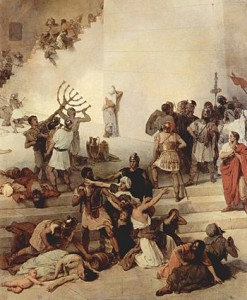
fall of jerusalemPopular Christianity taught me to be dubious and careful in regard to scholarship. Liberals and atheists are crouching everywhere, I was told, waiting to undermine my faith with science and reason. Some evangelicals welcome a modicum of safe, authorized scholarship to provide “background” for Bible reading, but as a rule modern scientific criticism is to be avoided and even combatted when necessary. And by far the greatest scholarly boogeymen are the “Jesus scholars,” those professors and researchers who have made their careers exploring the historical imprint left by Jesus of Nazareth. They present the greatest danger, we are told, because they want to deny Jesus’ miracles and divinity, and convince us that he was “just a man,” a guru not a savior.

For my part I’ve learned that scholarship – balanced, diverse, and collaborative – can actually help to correct and deepen faith. When we push past the false dichotomy of “faith vs. scholarship,” we enter into an ongoing and fruitful conversation between smart and helpful people across all kinds of disciplines and perspectives. If we filter out the voices of scholars because we’re afraid of what they might say, it says more about us than it does about the scholars. And when it comes to Jesus scholarship, I think Christians put themselves at a serious disadvantage by shutting it out. In the context of their discipline, most Jesus scholars are not on a mission to deny or debunk anything about Jesus, they are simply committed to exploring the historically explorable aspects of Jesus and his life. I want to briefly demonstrate how their work can add startling dimension to our understanding of who Jesus was and is.

What Scholarship Says About Jesus

For the purposes of this post I want to focus on one aspect of Jesus scholarship, namely what it has to say about Jesus’ teaching. Even more precisely, what it says about the “Olivet Discourse,” the apocalyptic prophecy delivered by Jesus to his followers shortly before his death (recorded with variations in Matthew 24, Mark 13, and Luke 21). Dense and cryptic compared with his ethical sayings, Jesus’ words in the Olivet have been a source of debate, distraction, and confusion for Christians of many stripes. Given its intensity and the eschatological fervor it has inspired, conservative believers might expect scholars to downplay Jesus’ “little apocalypse” in favor of his more palatable teachings about peace and brotherly love.

However, this is not the case. In fact, scholarly consensus identifies the apocalyptic sayings of Jesus as the authentic kernel of his public ministry. And while Christians may not need scholars to tell them what Jesus did or didn’t really say, consider what this tells us about the scholars and their willingness to draw conclusions apart from bias or agenda. Far from reducing Jesus to a mere teacher of moral self-help, they affirm that Jesus really did declare himself to be the Son of Man, and his self-identity and message were truly and primarily prophetic.

Going Deeper

But scholarship goes further than simply affirming the authenticity of Jesus’ apocalyptic sayings. It also places them in a corrective setting that illuminates them, challenges traditional assumptions, and (I believe) reveals something glorious about Jesus. Traditional churchly readings of the Olivet Discourse have interpreted Jesus’ words as a grim and cryptic warning about the end of the world in our own near-future. A careful reading, however, in dialogue with scholarship, takes Jesus’ words and their Jewish apocalyptic context seriously and sees instead an historically located prophecy which has already been fulfilled, thus punctuating his teaching and vindicating him as a true and prescient prophet, an unexpected and peaceable messiah. Scholarship cannot make these types of religious judgments, but it can equip us to interact with our ancient sources with intelligence and clarity.

Here is a quick overview of the Olivet Discourse from this perspective:

Jesus promised his followers that the Temple and Jerusalem itself would be destroyed, an inevitable judgment for the city’s addiction to violence and her political and spiritual rebellion. They asked him, “When will these things happen?,” and the Olivet was his answer. It is filled with specific predictions (“false messiahs will appear,“ “wars and rumors of war,” “one will be taken, the other left behind”) and bold apocalyptic images borrowed from the Hebrew Scriptures (“the moon will not give its light, the stars will fall from the sky,” “you will see the son of man coming on the clouds”). Each one of Jesus’ sayings, according to a scholarly reading, pertains to the destruction of Jerusalem by Rome in the Jewish War of 66-73 CE. False messiahs and failed revolutions? Check. Wars and rumors of war? Check. The Temple reduced to rubble? Check. Random murder and kidnapping by Roman forces? Check. The end of the Jewish world as they knew it? Check. Even the saying about the “son of man” in its original context in Daniel 7 is about the public vindication of God’s servant, not about rapture or second coming (the “coming” is upward, not downward, a possible analog to Jesus’ ascension?).

That is an all-too-brief breakdown of a very complex group of passages (explore more here  or here or here). There is much left to debate, to be sure. But there is one more crucial piece of evidence to consider. When Jesus finally gives an explicit answer to the disciples’ initial question (“When will these things happen?”) it is this: “I tell you the truth, this generation will not pass away before these things take place.” The scholarly view, in addition to taking the Jewish and first century contexts of Jesus’ words seriously, has the distinction of making sense of this promise. I can’t tell you how many awkward explanations I’ve heard over the years of what Jesus really means here. “This generation” refers to the church. He’s talking about apostolic lineage. It’s a metaphor for the twentieth century. On and on. But when the full picture of Jesus’ vision comes together, with invaluable assistance from scholarship, it seems downright obvious. Modern Christians may not consider the fall of Jerusalem to be an epic catastrophe with cosmic significance, but Jesus the Jewish prophet clearly did.

Why Scholarship Matters

Where traditional readings of the Olivet have led to endless speculation, politicizing, gloom, doom, and fear/warmongering, a reading informed by scholarship reveals Jesus as a true prophet whose message of repentance and judgment was vindicated by historical events. This in no way means that Jesus remains a mere artifact of history, his words bereft of meaning for the present or future. Nor does it mute the salient biblical hope for parousia, for the long-awaited ultimate fruition of God’s kingdom on earth. But how does a refreshed and vibrant new understanding of this troublesome passage inform how we read the rest of the New Testament? How does our posture toward world and neighbor change when Jesus’ lordship is not bound up with a promise of inevitable war that must be fulfilled before God’s kingdom can be realized? What does the fate of Second Temple Jerusalem say about the chance for repentance and peace in our own day?

Scholarship is a partner and companion that helps to illuminate questions like these. It cannot have the final word on matters of faith, but what human voice can? Where scholarship can offer correction and illumination, we would do well to give it a voice. If we think that we have nothing to learn from history, or that God would not allow us to err because we have a special religious arrangement with Him, then we need to hear Jesus’ call to repentance more than ever.

Share

Break Your Bible: Jeremiah 7 and What God Never Said

The first post in this series was met with almost deafening silence, but I’m forging ahead with this second one. I know I am pushing fairly hard against the grain of how most Christians have been taught to read their Bibles, but I don’t do so lightly or flippantly. On the one hand, there are surely more pressing issues facing us today than how we interpret the Bible. On the other hand, the way Christians respond to pressing issues is deeply affected by our traditional interpretations of scripture. This type of exercise might be the first step to laying a new and healthier foundation for Christian thinking and living.

Whereas the previous post explored the way we interact with the many streams of thought and belief represented in the Bible, today’s post concerns how the Bible interacts with itself. If Numbers 25 raised questions about how we identify and assess divergent voices in the Bible, our passage today unsettles our simplistic notions of biblical authority and uniformity. Jeremiah 7 is not only a major prophetic watershed in the Hebrew Bible, it is a text frequently quoted and alluded to by Jesus (it contains the bit about the Temple becoming “a robber’s den” and Jeremiah’s descriptive history of Gehenna). But before we can confront the surprising implications of the prophet’s words in verses 21-23, we have to take a moment to clarify what they actually say.

When Translators Attack!

Here is the text of Jeremiah 7:21-23 according to the 1985 update of the JPS Tanakh translation of the Hebrew Bible:

21 Thus said the LORD of Hosts, the God of Israel: Add your burnt offerings to your other sacrifices and eat the meat!
22 For when I freed your fathers from the land of Egypt, I did not speak with them or command them concerning burnt offerings or sacrifice.
23 But this is what I commanded them: Do My bidding, that I may be your God and you may be My people; walk only in the way that I enjoin upon you, that it may go well with you.

But those of us who grew up in the evangelical tradition were taught to stick with our familiar and safe NIV translation, which renders the same passage like this:

21 This is what the Lord Almighty, the God of Israel, says: Go ahead, add your burnt offerings to your other sacrifices and eat the meat yourselves!
22 For when I brought your ancestors out of Egypt and spoke to them, I did not just give them commands about burnt offerings and sacrifices,
23 but I gave them this command: Obey me, and I will be your God and you will be my people. Walk in obedience to all I command you, that it may go well with you.
[Emphasis added.]

The comparison of these two translations of the same Hebrew text highlights just how many choices a team of translators has to consider when producing an English version of the Bible. No two translators will ever make the same choices, and no single translation will ever capture the complete essence of what was originally written. But in addition to the stylistic variations between these two texts, there is one word in the NIV on which our entire discussion will hinge. Did you catch it? Right there in the middle of verse 22, it’s the word “just.” Four letters, one syllable, which completely changes the meaning of the passage.

What Did God Really (Not) Say?

In the JPS translation (based on the Masoretic Hebrew manuscript tradition) God via the prophet says, “Go ahead and eat up your own meat offerings, because I never said anything to your ancestors about burnt sacrifices. I just told them to obey me and walk with me!” But the NIV version tells a different story. Here God says, “Keep those sacrifices coming! But remember that I didn’t only give you commands about burnt sacrifices, I also told you to obey me and walk with me!” This is no minor discrepancy. In the JPS, God is utterly disinterested in burnt sacrifice, in fact He denies ever having asked for it in the first place. In the NIV, God demands uninterrupted burnt sacrifice.

Why would the NIV translators take it upon themselves to alter a text in this manner? How could the Bible of choice for fiercely conservative and “biblicist” readers justify changing an original author’s clear intent? What do they gain by tweaking the “word of God”? (I note here that even the ESV and King James Version render this passage according to the manuscript witness.)

I can think of at least two motivations for the NIV’s decision to alter Jeremiah 7:22. First, and most ironically, it preserves the appearance of consistency and inerrancy. You can’t have one part of the Bible saying that God never said or endorsed another part of the Bible. But more specifically, this verse threatens a precious evangelical theological assumption, namely that God demands blood payment for sin. This is a non-negotiable premise for certain configurations of atonement theory, for example. All translation is interpretation, and the NIV translators knew the interpretive expectations of their audience.

For more on questionable translation choices in the NIV, see this link: https://isthatinthebible.wordpress.com/articles-and-resources/deliberate-mistranslation-in-the-new-international-version-niv/

The Uncomfortable Implications of Jeremiah 7

Is Jeremiah claiming that the animal sacrifice laws in the Torah are illegitimate, a product of men and not God? What happens when a prophet seems to be saying that another part of the Bible doesn’t fully represent God’s word? I don’t offer any decisive answers to these questions, I just think it’s of paramount importance that we allow them to be asked. This is not about the reliability of the Bible, it’s about recognizing that a conversation is going on among the diverse texts of our tradition. I know inerrantists fear that questions like these will lead to doubt and undermine faith, but I don’t see how ignoring or neutering them is a healthier alternative to working them out in candor and hope.

It’s helpful, perhaps, to consider that Jewish interpreters have not found it necessary to edit or redact Jeremiah 7, and yet if the Temple were still standing they would surely resume making burnt sacrifices. Jews are (historically) more adept than Christians at allowing the Bible to speak, even in tension with itself, and yet living and flourishing within that tension.

The Beautiful Implications of Jeremiah 7

For my part I appreciate Jeremiah 7, both for the way it forces us to consider some heavy questions about how we read the Bible and for what it seems to be saying about God. This may be a disorienting text, but it’s certainly not the only voice in scripture suggesting that God is more concerned with integrity and mercy than He is with sacrifice. In fact, it’s a prophetic theme picked up by Jesus himself. How might such a clarification about God’s character alter or inform our understanding of Jesus, his death, or of our own relationship to God and other humans?

Jeremiah 7 is not a happy text. It’s a warning of calamity and coming judgment. But judgment comes not in the form of fire from heaven, it comes as a military enemy. The reason you face war and exile, says Jeremiah on behalf of YHWH, is not that your blood sacrifices were insufficient or insincere. Your problem is that you have not obeyed my commandments to honor your neighbor and care for the outcast. The God of Jeremiah is not impressed with religion and ritual, He is not thirsty for the blood of sinners or their animal substitutes. He longs to walk with humans in the way of selfless love.

The words of prophets are intended to ignite their hearers’ imaginations with possibility and hope. How can they do this if they cannot surprise us, if we refuse to let them diverge from a predetermined theological script?

Share

Break Your Bible: Numbers 25 and the Zeal of Phinehas

In this series of posts I want to use selected texts from the Bible to illuminate and challenge the way we read and interpret the whole collection. By saying “Break Your Bible” I’m not advocating that we reject, redact, or revise the contents of the biblical canon, but rather that we allow difficult components of the canon to stretch and complicate the things we think we know and believe about how it all fits together. This first post will focus on a story from the Hebrew Bible that defies simplistic interpretation, the second will examine a prophetic text that complicates our reading of the Torah, and last we’ll look at a Greek passage that raises similar issues in the New Testament.

The Myth of Phinehas

Numbers 25:6-13 is a brief account tucked away among the lengthy annals and genealogies of the Torah, but it resonates throughout the Bible. It’s a mythic story, which is a comment on its function, not its veracity. This is an interpretive re-telling of an ancient crisis. In the story, Israel is devastated by a mysterious plague that kills thousands, and a man named Phinehas takes matters into his own hands. When he discovers that an Israelite man has taken a wife from among the Midianites (their pagan enemies), Phinehas runs his spear through the couple, murdering them. The plague subsides, and God is so impressed with the “zeal” of Phinehas that he honors him, granting him an “everlasting priesthood.” The myth succinctly describes a problem (sinful marriage) and its solution (summary execution), leaving no question in the mind of the reader that this is the way the world works; our problems emanate from an angry God who can be appeased by acts of ritual violence.

The problems with this myth and its native interpretation are many and obvious, I hope. Most of us today, even Christians, do not believe in the theology that this story presents. In fact, those who do appeal to this kind of thinking usually end up making public apologies. We don’t believe that diseases and natural disasters are sent by God to punish us for our sins, and we don’t believe that assuaging God’s wrath is a matter of identifying and murdering the right sinners. We recognize that this type of “zeal” reflects an archaic and dangerous way of thinking about God and other people.

But It’s In the Bible!

At the same time, Christians who appeal to the Bible as a perfect and inspired authority must find a way to fit this story and others like it into the grand narrative of “what the Bible says.” That would probably go something like, “God hates sin, and this is how He dealt with it in ancient times.” And that might give way to, “But now we have Jesus, so God has dealt with sin in a better way!” This appeal to an “old covenant/new covenant” upgrade is a common way for Christians to interpret unsavory passages from the Hebrew Scriptures without having to judge them or disagree with them. This approach might have some merit when suggesting, for example, that the old system of animal sacrifice has been fulfilled and supplanted by the self-sacrifice of Jesus (an idea we will scrutinize in the next post). But it’s quite another to suggest that killing human infidels in God’s name used to be OK “back then.”

Attempts to gloss over a Bible story like this one are motivated by ignorance and/or fear. Either we haven’t bothered to look this kind of ugly “zeal” fully in the face, or we’re afraid to do so. If it doesn’t bother us, there is something deeply wrong. If it troubles us, we need to respond. The “zeal of Phinehas” makes an excellent test case for our ability to discern and address different traditions and voices in the Bible. It demands that we do what most Christians seem to fear the most, to make a personal judgment about something we read in the Bible.

The Zeal Tradition

The “zeal” modeled by Phinehas was idealized and lauded by later generations as reflected by a text like Psalm 106. The poem, reflecting on Numbers 25, says that Phinehas’ bloody deed was “counted to him as righteousness,” a strong statement echoing a famous reference to Abraham in Genesis 15:6. So bold and righteous was Phinehas that he is placed on a pedestal next to Abraham, the great father of the faith. Eventually “zeal” evolves into a code word for religious violence. “Zeal for the LORD” and “zeal for the Law” mean fierce allegiance to God and Torah, by the sword if necessary. By the time of Jesus an entire Jewish sect known as “Zealots” had dedicated themselves to liberating Judea by making war against Rome.

Religious zealotry was not some artifact of ancient life that fulfilled its purpose and became obsolete when Jesus arrived on the scene. It was, had always been, and continues to be a toxic and insidious element wherever religion is practiced. In the Bible, it’s not just relegated to the “Old Testament.” It pervades the entire library. The question is, are there other voices represented in the canon which offer an alternative vision of God and a counterpoint to the zeal of Phinehas? What an excellent question.

Jesus and Holy Violence

The same Bible that celebrates Phinehas also gives voice to Jesus, who was first and foremost a Jewish prophet and heir to the traditions of the Hebrew Bible (not a Christian critiquing them from the outside). Not only did Jesus’ message center around peace, nonviolence, and enemy love (Matt 5-7), he unequivocally refuted the theological assumptions at the heart of the Phinehas myth. Jesus rejected the idea that victims of violence and sickness were “sinners” who deserved their fate (Luke 13:1-5; John 9:1-3). He rebuked his followers when they suggested that God should smite those who reject his message (Luke 9:51-56). And he forbade Peter from defending him with a sword (Matt 26:52-56). In fact, his chief prophetic critique of his beloved Jerusalem was her addiction to retribution and violence (Luke 19:41-44).

Jesus does NOT say, “Well, I’m going to die on the cross so religious violence won’t be a necessary evil anymore!” No. His message is ethical as much as it is theological. Holy violence is wrong and it has always been wrong. God was never like that, and we must repent of having ever believed it was so.

The Zeal of Paul

The apostle Paul has a more direct confrontation with the “zeal” tradition. In fact, it’s part of his own story. In his letter to the Philippians, Paul lays out his credentials as a Jew and says the following: “…as to the law [I was] a Pharisee, as to zeal, a persecutor of the church…” (Philippians 3:5-6). Paul followed the zeal tradition vigorously, and it led him to orchestrate the violent persecution (in some cases the execution) of Christians. But Paul reports that he counts his old identity as “trash” since he became a follower of Jesus. Paul is converted from the way of violent zeal to the way of peace and “the surpassing worth of knowing King Jesus my Lord” (3:8).

Break Your Bible Open

This is not as simple as “Old Testament” versus “New Testament.” The Hebrew scriptures offer countless visions of the beauty of God and prophetic rejections of religious violence, while the bloody legacy of zeal continues beyond Jesus into the New Testament and even in our own day. There is no easy formula, we cannot avoid the hard work of interacting with each unique voice we encounter in the pages of scripture.

This exercise is meant to challenge and complicate the way we navigate the texts of the Bible. Why would we want to do that? Because it affords us the opportunity to wrestle with real and challenging questions instead of conducting a scavenger hunt of our own assumptions and predetermined beliefs. It puts us at risk of genuine shock, revulsion, illumination, and revelation. The familiar old approach, which presumes that the Bible is flat and univocal and must always agree with itself, leaves us deaf to the diverse claims, counterclaims, and arguments of the collected traditions. It dulls the edges of the Bible’s words so they cannot cut into our hearts.

The myth of zeal says that law keeping is more important than human lives. Jesus says that love for other humans is law keeping. This is what the Bible says. What next?

Share

The Narrow Path

While some teachings of Jesus are overlooked or obscured, others get used so often out-of-context that they take on a mutated meaning. In Matthew 7 (again), Jesus says:

13 Enter by the narrow gate. For the way is wide and easy that leads to destruction, and those who enter by it are many. 14 For the gate is narrow and the way is hard that leads to life, and those who find it are few.

In American Christianity, these verses are too often read through a prism of exclusivity and right belief. Groups obsessed with doctrinal certainty and cultural supremacy find in Jesus’ words an endorsement of their own agenda and a condemnation of all outsiders. I have seen these verses used to shut down young Christians with questions about the narrow beliefs of their particular church tradition. “Jesus told us that the way would be narrow, and that only a few of us would be saved!”

This way of thinking can bolster unhealthy certainty in abstract beliefs and poison the way believers perceive and interact with the world outside their church. It’s us (the redeemed, the faithful remnant) versus them (the unbelieving hordes). And for many American denominations, “them” does not consist merely of non-Christians, but also of the millions of Christians who do not profess the same configuration of belief that we do. Extremely narrow is the way, our way.

In context, however, Jesus’ words are not about religious belief, church, or exclusivity. They come at the end of Matthew’s “Sermon on the Mount,” a collection of ethical teachings given by Jesus to his students and a crowd of their Jewish neighbors. Having just described an ethically ideal worldview (and alternate reality) he calls the “kingdom of God,” Jesus issues a challenge and a warning: Not everyone will choose this narrow way of humility, empathy, and peace! In fact, most will hold to their course of violence, greed, and selfish living. One way leads to life, the other to self-destruction. It was a typically didactic (and Jewish) assessment of humanity’s dilemma, not a threat that God would only choose to favor a lucky select few. It aptly described the religious climate Jesus observed in his own moment, and it still hits home today.

The “narrow path” of Jesus doesn’t conform to the boundaries of religion or doctrine, in fact it cuts through all segments of humanity. Consider also Jesus’ parables of judgment (eg. Matthew 25:31-46). In the end, says Jesus, people from all nations and tribes are judged on ethical grounds, not according to how much they believed in correct religious ideas. In reality, we all know remarkable people from diverse traditions and walks of life who have chosen the narrow way, and many from our own tribe who have not.

As Christians, we “believe in Jesus,” but we must decide what this means for us. Does it mean belonging to an exclusive religious club which boasts Jesus as its mascot? Or does it mean trusting that the Way of Jesus truly does lead to life, wherever and by whomever it is embraced? Jesus did not teach and heal and die and rise so that there would be Christians, but so that humanity would be called loudly to the path that leads to life. Those who call ourselves his followers need to hear the call as much as anyone. We cannot imagine that religious affiliation or assent to doctrine places us on the narrow way.

Share

Hearing Voices in Scripture

As I’ve suggested many times, I believe that the standard Protestant and Evangelical methods of reading the Bible suffer greatly for denying or ignoring the polyphonal nature of the texts. By assuming a perfect consistency of voice and perspective (and technical “inerrancy”), we effectively silence the human conversations and arguments that characterize the Jewish tradition which produced the library we call “the Bible.”

Anyone who spends a good amount of time with the texts will inevitably encounter these disparate voices, but our traditions have trained us to respond in different ways. Some deny the subjective human dimension as far as they can, preferring to see God as the primary author of all scripture; any appearance of disagreement or problem being merely a cautionary demonstration. (“God wrote it, I believe it, that settles it!”) Others weave complicated apologetics designed to soak apparent discrepancies in reason until they dissolve together into a mush. (“Nothing to see here, folks!”)  Still others, unsure how to navigate surprising diversity and apparent dissonance, demote the Bible to secondary status. (That is, they just don’t read it.)

Readers grounded in these methods risk missing out on the defining human disagreements of the Bible (usually about the nature and character of God), and – most ironically – end up with a “perfect” Bible that isn’t very useful. The inevitable crisis of this approach is “what about this verse?” syndrome, whereby detached, out-of-context passages are used to challenge or even trump one another for appearing antithetical. “Don’t get too excited about that verse, what about this one over here?” The people who most loudly deny that scripture contains contradictions are the ones most likely to battle each other with contradictory verses.

Once we come to terms with the diverse threads of human opinion that run through the Bible, we can contextualize and explore them, we can discern and compare them, and we can work toward a holistic and robust understanding of the larger world that gave birth to the scriptures. Nowhere is this more urgent and crucial, I would argue, than the sayings and teaching of Jesus in the gospels. A flat, tone deaf view of the Bible will quote Jesus, a Psalm, Leviticus, and 2 Corinthians on an equal plane of authority, with the often deceptive qualifier “the Bible says!” Among the many problems with this approach: it doesn’t allow any of the texts to breathe and speak in their own space, and, what’s worse, it threatens to muffle and temper the voice of Jesus, the one voice in the biblical chorus that all Christians consider to be authoritative above others.  Heard on its own terms, the voice of Jesus should be free to harmonize, rhyme, contrast or disagree with any other voice we hear in the Bible.

These thoughts make a fitting backdrop to the post I published earlier this morning about Jesus and Christian Karma.


Share

Does the Bible “endorse” or “condemn” cultural institutions?

Critics of the Bible contend that it tacitly endorses harmful institutions like slavery, polygamy, leviration, the subjugation of women, ritualistic violence, and war. Few would deny that, on the surface at least, Bible texts provide a great deal of ammunition for such critiques. A popular Christian apologetic response, however, claims that the Bible cannot technically endorse anything sinful, and that, interpreted in the proper context, it actually condemns these institutions with divine authority. A rather empty expression of this assertion has been popping up in my Twitter and Facebook feeds in the form of this cartoon, but it has been argued with more dilligence and plausibility by apologist pastors like Tim Keller and D.A. Carson. For most evangelicals, this has become “common wisdom,” something everyone should know about how to read the Bible correctly. But does this truly and effectively answer the criticism? Is it clear from a plain and honest reading that the Bible denounces institutions like slavery and polygamy? The answer, like the Bible itself, is rather complex.

The Bible is fundamentally polyvocal, meaning that it is comprised of many diverse perspectives collected together. Interpretive communities (like churches and denominations) may emphasize certain thematic threads and choose to recognize these as a unifying divine “voice,” but the uninterpreted texts remain undeniably diverse and no two Christian interpreters have read every passage in the library in the same way. The problem with claims that the Bible “endorses” or “condemns” an idea or institution is that they typically sidestep the admittedly difficult work of interacting honestly with the various voices represented therein. While I personally believe it is possible to discover within the Bible an inspired trajectory away from harmful human systems and institutions, it is simply less than honest to say that the whole Bible explicitly and uniformly condemns them.

“Biblical” Marriage?

Marriage provides an interesting test case. In the Hebrew Bible polygamy is the norm and the ancient Israelites practice a form of levirate marriage in which a man’s brother is expected to marry and reproduce with his widow. Tim Keller has famously argued that the Genesis stories represent an implicit condemnation of these practices, since they yield chaotic results in every generation. There was a time when I found this response compelling and even echoed it in my own writing and teaching, but now I’m not so sure.

For one thing, it is a distinctly modern maneuver which projects our type of sensibility onto an ancient text. These institutions are absurd from our vantage point, but in the world which produced the Bible they were mundane. That’s not to say that the authors of scripture would refrain from decrying something just because it was familiar (prophets often passionately denounce the status quo). However, the Bible stories in question never explicitly censure the marriage practices of the patriarchs and, moreover, other texts that do address and regulate marriage for the Israelite community neither criticize nor prohibit polygamy or levirate marriage. In fact, by regulating these institutions the Torah laws (said to come directly from the mouth of God) might be said to affirm them. Later, in the New Testament, there are strong hints that a form of monogamous marriage has become culturally normative, though there is no formal repudiation of polygamy from any figure or author. Both Paul and Jesus seem to favor celibacy but acknowledge marriage as a fitting compromise for those with sexual inclinations.

Looking at this brief survey, can we say with confidence that the Bible either “condemns” or “endorses” polygamy, leviration, or any form of monogamous marriage? I don’t think we can. Different texts presuppose different forms of marriage. Different writers/speakers present different opinions about the nature and value of marriage. No specific form of marriage is ever denounced or recommended. It depends on what passage you’re reading.

Principles, Not a Blueprint

What the Bible does provide with remarkable consistency is spiritual and moral guidance regarding fidelity to relationships within one’s cultural context, whatever it might be. “Do not commit adultery” is a majority report, to coin a phrase. God’s people do not violate their covenants with one another or abuse their neighbors’ covenants. How this plays out in regard to marriage will look very different from culture to culture, from era to era. Attempts to reconstruct the cultural norms of an ancient world to solve the moral dilemmas of today are misguided and do real damage to the people caught up in the reconstruction.

It would be very convenient (for some, at least) if the Bible pronounced with more clarity which cultural institutions were acceptable and which were dangerous, but this is not what its contents were designed to do. Instead, they appealed to personal integrity and moral faithfulness within the cultural structures of their own time. It may not be easy to extrapolate and adapt those principles within a very different world, but that is the way forward for Christians who cherish the Bible and desire that it should inform the way they live. We seek principles that bear good fruit in the arena of real life, not a blueprint for conformity to an ancient ideal.

Of course, this question gets even more colorful when discussing topics like slavery and so-called “holy” war. Unlike marriage, these institutions are (almost, God help us) universally repudiated in the modern Western world. Exploring the Bible’s presentation of these realities is no less complicated and, frankly, often more disturbing. For my part, I would point to the divine voice, most loudly audible in the teaching and legacy of Jesus, that forges a radical trajectory away from exploitation and violence and toward empathy and egalitarian love. In that sense, I believe that the Bible represents a powerful, even heavenly condemnation of institutions that enslave and victimize. But this strand has to be discovered and embraced, and to find it we must be prepared to interact honestly and boldly with an ancient and disarmingly foreign library of books.

At the heart of this question is a bigger question, one that opens a larger can of worms. At the core of the evangelical response outlined above is the presupposition that God in some sense authored the Bible, and that criticism of the text thus amounts to criticism of God, which is unacceptable. This relates to the very volatile “inerrancydebate, and illustrates one of my major criticisms of inerrancy as a belief. If the evangelical’s first sworn duty is to defend God and His reputation, and if the Bible is somehow God’s “autobiography,” then it too must be defended at all cost. The result is that scripture cannot be read with open eyes, mind and heart, and difficult questions cannot be addressed honestly. And ultimately, ironically, the very potent truth at the heart of Bible will go untapped by those most eager to get their hands on it.

Share

More On the Post-Resurrection Stories

Mveng Resurrection Chapel of Hekima College Nairobi

Engelbert Mveng: Resurrection, Hekima College, Nairobi, Kenya, 1962.

I touched on this in my Easter post, but I want to say a little more about the details and ramifications of the post-resurrection appearances of Jesus in the synoptic gospels. Here are three deeply significant aspects of these strange tales that might have been obscured by traditional readings of the Bible.

1. Jesus returns in peace, unexpectedly.

Clearly no one in the gospel stories expected Jesus to be resurrected. Even when Jesus made cryptic predictions about his death and vindication, his followers told him to stop talking crazy and asked when he was going to become king and kill all the bad guys. As I’ve explored at-length elsewhere, the designation “messiah” had little to do with dying and coming back to life and everything to do with winning wars. After Jesus was executed, no one was looking at their watch wondering what was taking him so long. They were defeated and dejected. Their candidate was gone. The end.

And so when Jesus is resurrected, according to the synoptic gospels, it’s a surprise that completely blindsides his friends and followers. The shock and terror of the disciples is dramatized in the gospel texts, and we sympathize. Running into someone you watched die would be unsettling, to say the least. But once again, a deeper consideration of the historical and political background amplifies the drama. No one had ever imagined that a messianic candidate would die and be resurrected, but if that WERE to ever happen, surely the vindicated one would start the holy war to end all holy wars. With God clearly on his side, nothing could stop him. The disciples aren’t just scared because they think they’ve seen the ghost of a beloved friend, they’re staring at the risen body of the prophet they betrayed and abandoned. They must be thinking that judgment day is upon them.

But it wasn’t. Jesus announces “peace!” and tells them not to fear. The disciples (and innumerable Christian interpreters since) still want to know when the war will start, and Jesus lovingly smiles and shakes his head.

2. Jesus returns as a stranger.

The resurrection narratives in the gospels are diverse and sparse in detail, and they leave us asking many questions. In light of their ambiguity, however, continuities become more significant. For example, in every appearance story not a single person recognizes the risen Jesus on sight. From the final chapter of Matthew’s gospel to Paul’s vision in Acts, the resurrected Jesus is always encountered first as a stranger. This detail is easily overlooked, but its implications are staggering.

Quite in line with his expectation-defying career as a most unlikely messiah, Jesus is not portrayed as returning from the grave in public spectacle and revenge. His appearances are quiet and private, and his own friends don’t recognize him until they talk and eat with him. This Jesus is not the Jesus of triumphalism or culture war. This Jesus does not take over the world from an earthly seat of power, nor does he publicly shame those who don’t know him. He comes quietly alongside his followers and reveals himself in intimacy and friendship. An encounter with this Jesus is unexpected, a run-in with a stranger, a stranger who challenges and forever changes the way we look at things.

3. Jesus returns to affirm life, not “afterlife”.

The synoptic post-resurrection tales are remarkably brief, given their centrality and theological weight. As a result, we have tended to fill them out with our own assumptions and infer our own meanings. For many, the whole point of Jesus’ resurrection is to prove that heaven is real, and that Jesus can take us there with him if we negotiate a ticket. A peek at the texts, however, reveals a different agenda.

In Matthew, Jesus instructs his followers to go and make “disciples” (students) of his teachings who will keep his “commandments”. In Mark, the risen Jesus instructs the twelve to spread his message and “baptize” new followers.* In Luke, the most extensive of the narratives, Jesus reads scripture and eats with his followers, charging them with the task of being “witnesses” to his life and legacy. There is not a word about life after death or of his followers “going to heaven” when they die, but there is a clear mandate to proliferate his teachings. This includes his commandments to love God and neighbor, and his message of repentance and empathy.

Other texts will speculate about the nature of Jesus’ “appearing” at the “end of the age,” and of the fate of humanity and creation, but the gospels’ resurrection stories are clearly more concerned with the present. Here, Jesus’ legacy is first and foremost for this life, the one we’re living, for the well-being of his followers and of the whole world that God loves. This is the Risen Jesus we meet in the pages of the Bible and, hopefully, the one we seek in our lives.


*In Mark’s gospel proper, the risen Jesus says nothing at all. There are two “extra” endings, from 16:9 onward, widely considered to be later additions. It’s fairly easy to see why, even on the surface.

Share

Taking Easter Apart and Putting It Back Together Again

I’m easing my way back into blogging with some quick thoughts about Good Friday and Easter.

Growing up Evangelical, I learned to think about Holy Week within a certain framework (for one thing, we never called it “Holy Week,” we called it “the week before Easter”). Here’s what I used to believe about Easter. Not that I could necessarily have articulated all or any of this, but these were the assumptions and implications of our beliefs:

  • Jesus died as part of God’s Master Plan to assuage His wrath via human sacrifice, a plan that came together with precision in fulfillment of very specific ancient prophecies. None of the players in the story was acting outside of God’s Plan.
  • God needed Jesus to die so He could legally forgive our sins, so we can also say that we helped to kill him by committing the sins that necessitated the sacrifice. If we had not sinned, Jesus would not have had to die.
  • The shedding of Jesus’ blood propitiates (satisfies) God completely, but not universally and not automatically. For the sacrifice to be effective, one must convert to Christianity and believe in the sacrifice. Anyone who does not do this cannot enter Heaven when they die, since they have not taken advantage of the legal mechanism provided by the sacrifice.
  • Jesus’ resurrection was miraculous and triumphant without diminishing the effectiveness of his sacrificial death. God raised Jesus once the sacrifice was complete as a proof of his divinity and of afterlife. God brought Jesus back to heaven to prepare an eternal home for true believers.

Here are just some of the problems that swarmed my mind and heart as I grew up and learned to think through these beliefs:

  • Why does the God who (according to the Old Testament) ABHORS human sacrifice and who ultimately (according to the prophets and Jesus himself) REJECTS all sacrifice hatch a Master Plan that involves manipulating humans to carry out the horrific execution of a truly innocent person? Do we really believe that shedding the right blood was the key to pleasing God all along? What does this say about the character of God and the nature of the universe He created?
  • How can anyone (even God) conceivably satisfy their own anger, legally or otherwise? How does orchestrating a sacrifice for Himself “deal with sin” and make God happy enough to absolve a few humans of their guilt?
  • What is the level of accountability for the human pawns in God’s Master Plan? The priests and crowds demanded Jesus’ death, Pilate ordered it, and the Roman soldiers carried it out, but weren’t they carrying out the holy will of God? In this way, weren’t their actions strangely sacred? Is it wrong for God to hold them responsible for fulfilling the ancient prophecies He arranged “from the foundations of the world”?
  • If the death of Jesus has the power to heal and save, how is that power limited to only those who “believe in it” in a certain way? Doesn’t this put the onus of salvation onto humans and their decision to think or not think certain thoughts? And how does the salvation of a small remnant of humanity fit in with the Bible’s vision of renewal and rescue for all of creation?
  • If Jesus’ death was legally satisfying to God, does the resurrection in any way dilute or complicate its effectiveness? If the death of an innocent is required to “pay for sin,” how could God be pleased and placated by a death that is not “final”?

Here are some fresh thoughts about Good Friday and Easter. These are not the “correct” beliefs, they are my current best attempts at interpreting and appreciating this story I’ve inherited:

  • God did not kill Jesus. We did. And we did it not by committing isolated and disparate personal sins but by ACTUALLY KILLING HIM. The violence of human religion and empire conspired to murder Jesus. And if a prophet appeared among us today preaching empathy and a forgiving God, we’d murder him or her too. That is the scandal of Good Friday.
  • Resurrection is not the triumphant epilogue that gives the story a happy ending, assures us of heaven, and helps us win the culture war by following the correct religion. Resurrection is both a vindication of Jesus’ legacy and God’s non-violent rejection of our attempt to scapegoat and sacrifice His Son. It’s God’s “no thank you!” to our disgusting rituals and violence which were exposed on the cross.
  • Jesus does not come back to seek revenge or “settle the score” (as his followers clearly expected), he comes with “peace” on his lips, announcing a new world. His followers still didn’t get it, so he promised that his spirit would always be with them to guide them, if only they’d listen. If only we’ll listen.
  • Salvation is not achieved by rolling around in the magic blood of an innocent scapegoat. It is found in the light of Easter morning, in the hope of New Creation, and a willingness to follow in the Way of selflessness and vulnerable love. Jesus saved us from our sins by exposing their true nature, absorbing our hate and offering us the opportunity to repent of our violence and self-destruction.
  • We seek the presence of the Risen Jesus, not as our Holy Emperor leading us to conquest, but as the One who announces shalom and the end of violence and sacrificial thinking. Each Easter, like every new day, is another chance to open our eyes to this astonishing reality.
Share

3 Defining Aspects of My Evolving Faith

Just a quick little post today but with some big ideas. Like many Christians of roughly my age and upbringing, I have experienced in recent years what I’m tempted to call a “faith journey.” That’s a timid way of saying that my Christian identity has evolved into something radically different from what it was, and continues to change. A lot. Every day. Taking stock of these changes and discoveries, I realize that there are at least three major aspects of Christian faith that have changed profoundly for me. They are Bible, Jesus, and Faith itself. Here’s what I mean:

1. I acknowledge that our Bible consists of many human voices in conversation, often argument, and that genuine interaction with scripture will inevitably involve discerning those voices and (here’s the dangerous part) picking sides. If we learn to navigate the tribal, violent, sacrificial, exploitative, divisive rhetoric of the inspired religious minds that wrote the texts, we can encounter Jesus in his historical habitat and discover his divine beauty, all the more loud and clear for its proper context. This is how I believe our Bible can and does reveal truth about God, as often in spite of what it says as by it.

2. Jesus’ teaching is amplified by his death and resurrection, not diminished or irrelevant in light of them. The glorification/deification of Jesus represents a validation and veneration of his prophetic message, not the turning of a corner whereafter his earthly sayings are no longer as relevant or appropriate. Being God’s son, in ancient parlance, meant (at least) that one was like God. If Jesus is God’s Son, it means (at least) that God is like Jesus: meek, mild, driven by love and empathy, calling people to abundant life, exposing the emptiness and futility of human systems of sin and domination. To imagine that Jesus has abandoned his humble human vocation in order to become the Emperor of Heaven is to willingly lose sight of his own stated values and of the Kingdom of peacemakers he claimed to establish. Jesus’ divinity and supremacy are demonstrated at Easter, not in some future hostile takeover. To await his appearance (or “second coming”) is to anticipate the advent of peace and light, not doomsday.

3. True “faith” consists in trust and hope, not mere belief. In fact, faith-as-trust anticipates and acknowledges doubt. If salvation or transcendence depend on conformity of doctrinal belief, then most all of us are doomed – even (or especially) those who are consumed by theological correctness. “Faith” and “belief” in the language of the Bible refer to a living and vulnerable trust in the person Jesus, a counter-cultural hope that his Way is the way of life. We can hold a wide variety of technical beliefs about religion and the nature of everything, but faith in Jesus means that when both world and religion begin to look wrong and hopeless, we can find meaning and identity in Jesus, the one who was faithful to his own Way to the point of death, and of whom (we believe) God has made a victorious and peaceful example.

This is brief and incomplete by design, it is meant to provoke thought and invite discussion.

Share

Four Ways Jesus Loved His Enemies

Jesus enemiesEveryone knows that Jesus said something somewhere about loving our enemies, but to look at his followers you’d think it was just a passing suggestion or a euphemism for something much more complicated. Many modern factions of Christianity are not unlike other insular groups, very sure of who our enemies are and what God has in store for them. Even the prophets and apostles of scripture can’t seem to resist defaulting to an “us versus them” mentality, which only fuels today’s followers by providing them with “biblical” rhetoric about God’s impending vengeance on the bad guys. (Watch Paul wrestle with enemy love in Romans 12:14-21, and see him get downright scary in 2 Thessalonians 1:5-12.) We give those ancient authors a pass because of the times and culture in which they lived and for the persecution they faced, but the fundamental problem persists. The results today range from easily ignored pop-culture revenge fantasies  to deeply disturbing calls to arms against specific groups of perceived enemies.

Was Jesus simply being unrealistic when he commanded his followers to “love your enemies and pray for those who persecute you” (Matt 5:44)? Some have taken an approach similar to Paul’s in Romans 12; we should outwardly tolerate our enemies right now like Messiah said, but only in anticipation of judgment day when he’s coming back to settle the score. We win, they lose, we just have to bide our time. But that’s not so much “love” as it is “sanctimonious condemnation and self-delusion.” The Romans 12 approach is really just the 2 Thessalonians 1 approach with a smiley face painted on it.

What about Jesus? Did he practice what he preached vis-à-vis enemy love? The biblical evidence indicates that radical empathy and subversive affirmation of the “other” are central to both Jesus’ message and his legacy. Here are just four ways that Jesus modeled love of enemy, according to the gospel accounts.

1. Jesus refrained from cursing Israel’s enemies

Jesus stood in the tradition of Israel’s prophets. The earliest prophets saw their task as twofold: 1) admonish Israel’s kings and priests on behalf of YHWH, and 2) comfort the nation by pronouncing divine wrath upon her enemies. Later prophets (like Isaiah and Jeremiah who were a major influence on Jesus) intensified their challenge to Israel, especially in light of the “curse” of exile, but still maintained that God would ultimately and eternally punish the pagan powers who carried the curse out. Jesus picked up the prophets’ call for reformation (he called it “repentance”), but he dropped the oracles of fire and brimstone against Israel’s enemies. He spoke some harsh and difficult words, but the worst of them were reserved for the religious authorities in his own land. This is not to say that that he condoned or ignored the brutality of Rome (for example), it simply demonstrates that he made a conscious decision not to frame his prophetic message in terms of “us versus them.”

2. Jesus told stories that inspired empathy for enemies

Along the same lines, Jesus told parables to ignite his followers’ imaginations and to challenge their presuppositions. A major theme of his storytelling is a radical rethinking of both “us” and “them.” One of the best known stories concerns a detested political and ethnic enemy who turns out to be an Israelite’s true “neighbor” (Luke 10:25-37). To love this neighbor as much as oneself, says Jesus, is to know God. In one sense Jesus’ parables are subversive and shocking, and yet they are not without precedent in his own tradition. Hebrew texts like Ruth and Jonah (both invoked by gospel authors) offered stunning and countercultural portrayals of hated enemies as sympathetic and beloved of God. Jesus claimed and amplified this vision.

3. Jesus interpreted scripture by filtering out violence and retribution

It is fascinating when studying the gospel texts to consider when and how Jesus invokes the Hebrew Scriptures in his teaching. Which books does he quote? Which books does he not quote? Which passages does he quote, and when? What does he leave in, what does he leave out? There is a growing scholarly interest in “how Jesus read his Bible.” One of the patterns that emerge from such a study is Jesus’ apparent intentional hermeneutical move away from violence and vengeance. This finds broad expression in the way Jesus reframed the Torah law to focus on relationships and empathy rather than technical compliance (see Matthew 5:21ff.). But consider also Luke 4:16-30, wherein Jesus quotes Isaiah (61)’s announcement of “the year of YHWH’s favor” (when God rescues “us”) but omits the very next line about “the day of God’s vengeance” (when God punishes “them”). By the end of the passage, Jesus’ disappointed neighbors are trying to throw him off a cliff. This dimension of Jesus’ bible teaching is challenging on a number of levels, in its original context and our own. (This topic is addressed in a fascinating book called Healing the Gospel by Derek Flood, who is currently writing another book specifically about violence in scripture.)

4. Jesus blessed his enemies as they murdered him

It’s one thing to avoid hateful rhetoric and to reconfigure an abstract religious/political framework around love and empathy. It is quite another to stare an enemy in the face as he brutalizes you and to declare him “forgiven.” This is exactly what Luke portrays (in chapter 23) when Jesus is crucified and prays, “Father, forgive them, they don’t know what they are doing.” The ramifications of this moment in the gospel narrative cannot be overstated. On the one hand, our notions of right, wrong, and forgiveness are turned inside out, as a divine agent pronounces forgiveness over unrepentant murderers. At the same time, Jesus is living out his own teaching to the utmost extreme, practicing his preaching to a confounding end. It is one of the great climactic moments in our Bible, second only to what comes a chapter later. (And there’s more that could be said about the non-vengeful nature of the resurrection tradition in contrast with popular messianic expectations.)

————-

Of all the moral imperatives in scripture, none remains more elusive and challenging than Jesus’ call to empathy and selfless love. This is the theme not just of his teaching, but of his life, his death, and his glorious legacy.

Share